How HPLC Testing Works for Peptide Purity
Why HPLC Is the Gold Standard for Peptide Purity Testing
Understanding HPLC peptide purity is essential for any researcher interpreting Certificate of Analysis data. High-Performance Liquid Chromatography (HPLC) is the analytical method that underpins virtually every COA in the research peptide industry. When a vendor claims 99%+ purity, that number almost always comes from an HPLC analysis. Understanding how this technique works — and what it can and cannot tell you — is essential for interpreting COA data and making informed purchasing decisions.
HPLC separates the components of a mixture based on their differential interaction with a stationary phase (typically a column packed with modified silica particles) and a mobile phase (a solvent gradient). When a peptide sample is injected into the HPLC system, the target peptide and any impurities travel through the column at different rates depending on their chemical properties — primarily size, charge, and hydrophobicity. The result is a chromatogram showing distinct peaks at different retention times, with each peak corresponding to a different component of the sample.
Reading an HPLC Chromatogram
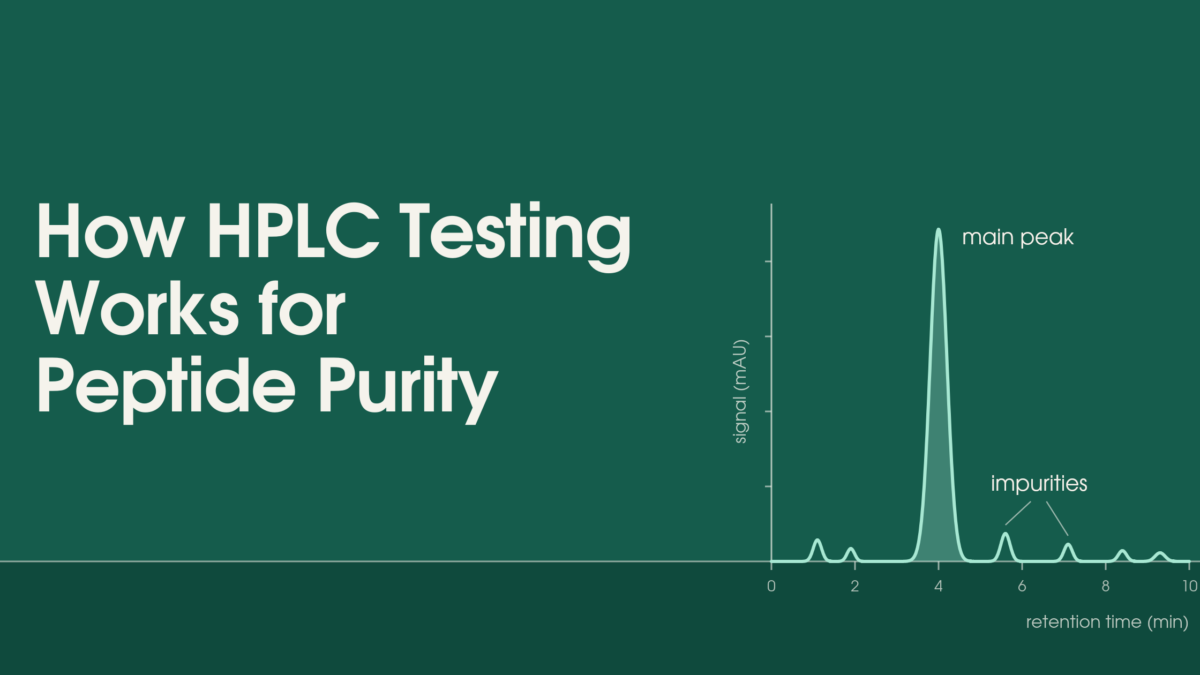
To understand how HPLC testing works for peptides, start with the chromatogram — the primary output of an HPLC analysis and the data that appears on most COAs. Understanding what it shows — and what it does not show — is critical for evaluating peptide purity claims.
The dominant peak on the chromatogram represents the target peptide. Its area relative to the total area of all peaks is the purity percentage reported on the COA. A “99.2% pure” result means the target peptide peak accounts for 99.2% of the total detected material, with the remaining 0.8% distributed across smaller impurity peaks.
Common impurities in synthetic peptides include deletion sequences (where one or more amino acids were skipped during synthesis), truncation products (incomplete synthesis), oxidized variants (particularly for methionine-containing peptides), and deamidation products (asparagine or glutamine converted to aspartate or glutamate). Each of these appears as a distinct peak on the chromatogram at a different retention time than the target peptide.
The detection method matters. Most peptide HPLC analyses use UV detection at 214 nm or 220 nm, which detects the peptide bond absorption. This is appropriate for most peptides but has limitations: it cannot distinguish between peptide impurities and non-peptide contaminants that absorb at the same wavelength, and it may undercount impurities that have weak UV absorption. More advanced detection methods — such as mass spectrometry (LC-MS) or evaporative light scattering detection (ELSD) — provide complementary information that UV detection alone misses.
What HPLC Cannot Tell You
Knowing how HPLC testing works for peptides also means understanding its limits. HPLC purity is necessary but not sufficient for complete quality assessment. Several important quality parameters require different analytical methods.
Peptide identity cannot be confirmed by HPLC alone. Two different peptides of similar size and hydrophobicity can produce peaks at similar retention times. Mass spectrometry (MS) is required to confirm that the compound matching the dominant HPLC peak is actually the target peptide and not a co-eluting impurity with similar chromatographic properties. This is why high-quality COAs include both HPLC purity and MS confirmation — the HPLC tells you how pure the sample is, and the MS confirms what the dominant component actually is (PubMed: HPLC-MS Peptide Quality Control).
Endotoxin (bacterial lipopolysaccharide) contamination requires a dedicated Limulus Amebocyte Lysate (LAL) test. Endotoxins are not detected by standard HPLC methods and can be present even in samples with 99%+ HPLC purity. For injectable peptide research, endotoxin testing is critical because even trace levels can produce significant biological effects that confound research results. The USP Chapter 85 standard referenced on many COAs defines the acceptable endotoxin levels and testing methodology.
Residual solvents from the synthesis and purification process (acetonitrile, TFA, DMF) are not detected by standard peptide HPLC methods. Gas chromatography (GC) or headspace analysis is required to quantify residual solvents. Most research-grade COAs do not include residual solvent testing. Our independent vendor evaluation for 2026 assesses which vendors provide the most complete documentation, which represents a gap in the quality documentation that researchers should be aware of.
Net peptide content — the actual amount of active peptide in a weighed sample — is often lower than the gross weight. Lyophilized peptide powders contain counter-ions (typically TFA or acetate salts), residual moisture, and other non-peptide mass. Net peptide content testing (by amino acid analysis or nitrogen determination) reveals the actual peptide mass fraction, which can range from 50-85% of the gross weight depending on the peptide and lyophilization conditions. This means a vial labeled “10 mg” may contain only 5-8.5 mg of actual active peptide.
How to Evaluate a COA: A Practical Checklist
Now that you understand how HPLC testing works for peptides, applying that knowledge when reviewing a vendor’s COA documentation, the following checklist helps assess the thoroughness and reliability of the testing.
Lab identification. Is the testing laboratory identified by name and certification number (CLIA, ISO 17025, or equivalent)? Anonymous COAs — those without an identified lab — cannot be independently verified and should be treated with appropriate skepticism.
Batch specificity. Does the COA reference a specific batch or lot number? Vendor-wide “representative” COAs that cover an entire product rather than a specific production batch are less meaningful than batch-specific documentation, because quality can vary between production runs.
HPLC method details. Are the column type, mobile phase composition, gradient program, and detection wavelength specified? These details allow independent labs to reproduce the analysis. COAs that report only a purity percentage without method details cannot be independently verified.
Mass spectrometry confirmation. Is an MS spectrum included showing the expected molecular weight? The MS data confirms peptide identity independently of the HPLC retention time. Look for the expected molecular ion peak [M+H]+ at the correct mass-to-charge ratio for the target peptide.
Endotoxin testing. Is LAL endotoxin testing included? If so, is the result reported in EU/mg (endotoxin units per milligram) with reference to the USP Chapter 85 standard? For injectable research applications, endotoxin testing is not optional.
No single vendor provides perfect documentation across all these dimensions. The 2026 FDA peptide reclassification has also raised the stakes for quality documentation across the industry. The goal is not perfection but informed assessment — understanding what a COA tells you, what it doesn’t tell you, and what additional testing would be needed to fill the gaps for your specific research application (Wikipedia: High-Performance Liquid Chromatography).
Frequently Asked Questions
What does 99% purity actually mean on a peptide COA?
It means the target peptide accounts for 99% of the total material detected by HPLC at the analysis wavelength (typically 214-220 nm). The remaining 1% consists of synthesis impurities — deletion sequences, truncation products, oxidized variants. It does not account for non-peptide contaminants (endotoxins, residual solvents) or net peptide content, which require separate testing methods.
Is HPLC purity the only test that matters?
No. HPLC tells you how pure the peptide fraction is, but mass spectrometry confirms identity, endotoxin testing ensures sterility for injectable research, and net peptide content reveals actual active compound mass. Complete quality assessment requires multiple complementary methods, not just HPLC alone.
Can vendors fabricate COA results?
COAs from unidentified labs cannot be independently verified. The most reliable COAs come from identified, certified laboratories whose credentials can be checked. Independent third-party testing — sending a sample to a lab with no commercial relationship to the vendor — is the only definitive verification method.
What is net peptide content and why does it matter?
Net peptide content is the fraction of a lyophilized powder’s weight that is actual active peptide, typically 50-85%. The remainder is counter-ions, moisture, and salts. A vial labeled “10 mg” may contain only 5-8.5 mg of active peptide. This matters for accurate dosing in research protocols and explains why reconstitution calculations should account for net peptide content when precision matters.
PeptideQuill provides independent research news and analysis. This content is for informational purposes only and does not constitute medical advice.