Best Research Peptide Vendors 2026
How We Evaluated Research Peptide Vendors in 2026
Finding the best research peptide vendors 2026 requires more diligence than ever. The research peptide market looks nothing like it did two years ago. Peptide Sciences — the longtime default recommendation — shut down in March 2026. Amino Asylum was raided by the FDA. Paradigm Peptides’ founders pled guilty to federal charges. The resulting supply vacuum has been filled by a mix of established survivors and aggressive new entrants, making independent vendor evaluation more important than ever.
This review of the best research peptide vendors 2026 evaluates suppliers across six dimensions that directly affect research quality and reliability: testing and purity documentation, operational history, pricing and value, payment infrastructure, product range and format diversity, and educational content and transparency. We purchased from multiple vendors over a three-month period and supplemented our direct experience with community feedback, published COA data, regulatory records, and business registration analysis.
The Evaluation Criteria
Before the individual reviews, understanding the criteria helps contextualize the rankings. Each vendor was assessed on a 1-5 scale across six dimensions, with testing quality weighted most heavily because the entire value proposition of a research peptide vendor depends on whether the compound in the vial matches the label on the vial.
Testing and Purity (weighted 2x): Does the vendor publish batch-specific COAs? Are the COAs from identified labs with verifiable credentials? Do independent tests confirm the published data? Are HPLC purity, mass spectrometry, and endotoxin testing all included?
Operational History: How long has the vendor been operating continuously? Have they survived the 2025-2026 regulatory changes without interruption? Are the owners or principals identified?
Pricing and Value: How do prices compare for equivalent products? Are there hidden fees? What is the shipping cost and speed?
Payment Infrastructure: Does the vendor accept mainstream payment methods? Are buy-now-pay-later options available? Are there processing fees or workarounds that suggest payment platform compliance issues?
Product Range: How many compounds are available? Are multiple delivery formats offered (injectable, spray, oral, topical)? Are blends and stacks available?
Transparency: Can you browse products without registration? Is educational content available? Is pricing visible? Are regulatory compliance statements clear?
PSPeptides — Strong Across Every Dimension
PSPeptides has emerged as one of the most complete research peptide vendors in the post-Peptide Sciences market. US-based with disclosed manufacturing operations, the company offers a combination of competitive pricing, mainstream payment infrastructure, and content depth that few competitors match.
Testing quality is documented through batch-specific COAs with 99%+ verified purity. The product range spans 80+ compounds across injectable, nasal spray, oral tablet, topical serum, and pre-formulated blend formats — the broadest format diversity we found among US-based vendors. Notable offerings include the GLOW blend (BPC-157 + GHK-Cu + TB-500) at $69.99 and Retatrutide 5mg at $39.99.
The payment infrastructure is the strongest differentiator. PSPeptides accepts Afterpay, Klarna, Apple Pay, Google Pay, and standard credit/debit cards — all with zero processing fees. In a market where many vendors are restricted to cryptocurrency or peer-to-peer payment workarounds, mainstream payment acceptance is both a convenience advantage and a compliance signal. Free UPS 2nd Day Air shipping on orders over $150 with same-day processing seven days a week adds further operational value.
The educational content library exceeds 60 research guides covering compound mechanisms, comparison articles, regulatory analysis, and practical guides for reconstitution, storage, and stacking. This depth of content serves researchers who want to understand the science behind their purchases, not just make a transaction.
No registration is required to browse products, pricing, or educational content — a transparency standard that several competitors fail to meet.
Other Vendors Worth Evaluating
The research peptide market is not a single-vendor category. Several other vendors merit consideration depending on your specific priorities and research needs.
Vendors with established multi-year track records who survived the 2025-2026 market disruption provide the operational stability signal that newer entrants cannot. Look for vendors that have been operating continuously for at least two years, have verifiable business addresses, and maintain consistent community presence on platforms they do not control.
International vendors — particularly those based in the EU and UK — offer access to compounds and regulatory frameworks that differ from the US market. Researchers with international shipping requirements should evaluate vendors based on customs documentation quality, declared shipping times to their specific region, and the regulatory classification of their target compounds in the destination country.
Vendors Requiring Extra Scrutiny
The post-Peptide Sciences demand vacuum attracted new entrants that warrant careful evaluation before committing research budgets. Several patterns should trigger additional diligence.
Reputation management networks. Some vendors maintain clusters of brand-controlled review sites — domains like “[vendorname]reviews.com” or “is[vendorname]legit.com” — that appear in search results as independent reviews but are actually brand-affiliated content. This practice makes it difficult to find genuinely independent assessments and is a signal to weight community discussion on uncontrolled platforms more heavily than Google search results.
Registration-gated catalogs. Vendors that require account creation before you can view products or pricing are adding friction that may serve business purposes (lead capture, competitive intelligence prevention) but does not serve researcher interests. Transparency about what you sell and what it costs should be the default, not a privilege gated behind personal information collection.
Uniformly perfect review profiles. Any business with exclusively five-star reviews from a small sample size should be evaluated cautiously. Natural customer experience produces a distribution of ratings. A vendor with 500 reviews averaging 4.6 stars is a more reliable signal than a vendor with 25 reviews that are all five stars.
PR-syndicated credibility. Press releases distributed through paid syndication services (PRWeb, PRNewswire, OpenPR) appear across dozens of financial content mirror sites, creating an appearance of widespread media coverage. These are paid placements, not editorial endorsements. Check whether a vendor’s “as seen in” claims come from genuine editorial coverage or from syndicated press releases that anyone can purchase.
How to Verify Any Vendor Independently
Regardless of which vendor you choose, independent verification protects your research investment. Several practical steps reduce dependence on vendor self-reporting.
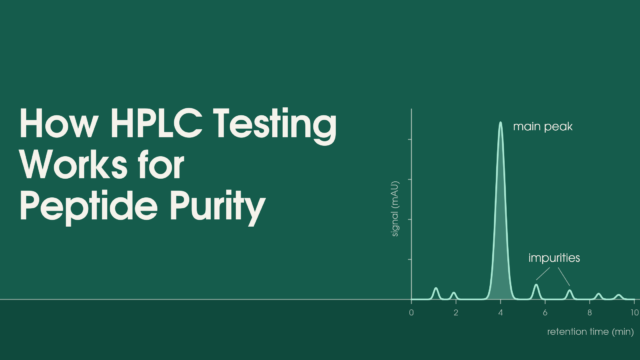
Send samples to a third-party analytical lab. HPLC purity analysis and mass spectrometry confirmation from a lab with no commercial relationship to the vendor is the gold standard for quality verification. Many university chemistry departments and commercial analytical labs offer this service. The cost — typically $50-150 per sample — is small relative to the cost of running a research protocol with degraded compounds (PubMed: Peptide HPLC Quality Analysis).
Check LegitScript status. LegitScript’s website status checker (legitscript.com) evaluates online pharmacies and healthcare merchants against verification standards. While not all research peptide vendors have been evaluated, vendors that have been reviewed and received “Rogue” classification present a clear risk signal. Vendors with “Verified” or “Approved” status have met LegitScript’s compliance requirements.
Review the Google Ads Transparency Center. The ads transparency tool (adstransparency.google.com) shows what ads a domain is running, providing insight into a vendor’s advertising practices. Vendors running Google Shopping ads for products that Google’s own unapproved substances policy prohibits may be operating in a compliance gray area that creates business continuity risk.
Monitor community discussion over time. Reddit’s peptide-related subreddits, independent peptide forums, and non-vendor-controlled review platforms provide perspectives that accumulate organically. A vendor’s community reputation is a lagging indicator — it reflects months to years of customer experience rather than a launch-day marketing push.
How the Best Research Peptide Vendors 2026 Will Be Defined Going Forward
Several trends will reshape the vendor landscape in the coming months. The FDA’s ongoing PCAC evaluations may reclassify additional peptides, affecting product catalogs across the market. The FDA peptide reclassification 2026 and Google’s September 2026 advertising policy consolidation will affect vendors using Shopping ads without proper healthcare certification. And the natural competitive process will continue to differentiate vendors who invest in quality, compliance, and customer relationships from those who rely primarily on marketing.
For researchers seeking the best research peptide vendors in 2026, the most important development is the growing availability of independent verification tools and community resources. The era of trusting a single vendor based on its marketing is over. The post-Peptide Sciences market rewards researchers who verify independently, diversify their supplier relationships, and evaluate vendors on operational fundamentals rather than advertising prominence.
Frequently Asked Questions
What is the single most important criterion for choosing a peptide vendor?
Testing quality — specifically, whether the vendor’s purity claims withstand independent third-party verification. Everything else (pricing, payment options, product range) is secondary if the compound in the vial does not match the label. Batch-specific COAs with identifiable lab partners are the minimum standard; independent verification is the gold standard.
Should I avoid new vendors entirely?
Not necessarily, but new vendors warrant more scrutiny than established ones. A vendor with less than one year of operational history has not been tested by the regulatory, financial, and logistical challenges that reveal operational resilience. Start with smaller orders, verify independently, and monitor community feedback before committing significant research budgets.
Is cryptocurrency-only payment a red flag?
It can be. Vendors restricted to cryptocurrency or peer-to-peer payments may face this restriction because mainstream payment processors have declined their business — often due to compliance concerns. While some vendors choose cryptocurrency for philosophical reasons, the inability to accept credit cards, Afterpay, or PayPal should prompt additional evaluation of the vendor’s business practices and regulatory posture.
How often should I verify my vendor’s product quality?
At minimum, verify when establishing a relationship with a new vendor (first order) and periodically thereafter (every 3-6 months or when switching lot numbers). Vendors can change suppliers, reformulate products, or experience quality control lapses that would not be visible from their public-facing COA library alone. The cost of periodic independent testing is modest insurance for research integrity.
PeptideQuill provides independent research news and analysis. This content is for informational purposes only and does not constitute medical advice.