Google Cracks Down on Peptide Ads: What September 2026 Changes Mean
What Google’s September 2026 Policy Consolidation Changes
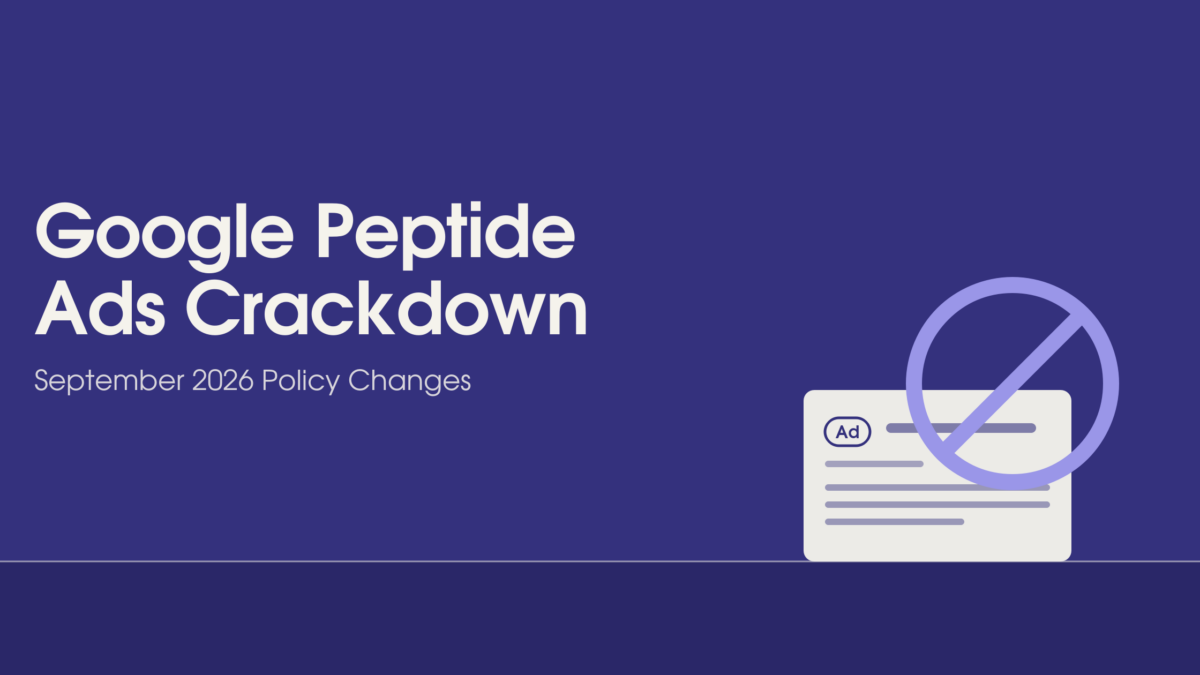
Google’s September 2026 advertising policy consolidation represents the most significant change to peptide ads rules since the company first began enforcing healthcare restrictions on Shopping ads. The update merges the previously separate policy frameworks for free Merchant Center listings and paid Shopping ads into a single enforcement regime — meaning vendors who appeared in free product listings through classification workarounds now face the same healthcare restrictions that have long governed paid ads.
For the research peptide industry, this change has immediate and practical consequences. Several vendors currently visible in Google Shopping results — including at least one classified as a “Rogue” pharmacy by LegitScript — will likely lose that visibility entirely unless they hold legitimate healthcare merchant certification.
How Peptide Vendors Appeared in Google Shopping Before the Change
Google’s healthcare advertising policies have always prohibited the promotion of unapproved pharmaceutical products, including most research peptides. Specific compounds — BPC-157, TB-500, semaglutide, tirzepatide, and others — are explicitly named in Google’s unapproved substances list. Running paid Shopping ads for these products without proper certification has been a policy violation since the restrictions were first implemented.
However, Google’s free Merchant Center listings operated under a different enforcement framework. Vendors could submit product feeds classified under non-restricted categories — “laboratory supplies,” “research chemicals,” “cosmetics” — and appear in Google’s unpaid Shopping grid without triggering the healthcare policy checks that paid ads required. This classification workaround was not explicitly permitted, but enforcement was inconsistent enough that some vendors maintained Shopping visibility for months.
The September 2026 consolidation eliminates this gap. Free listings and paid ads now undergo the same policy review, the same category verification, and the same healthcare restriction enforcement. A product that would be rejected as a paid ad will now also be rejected as a free listing (Wikipedia: Google Ads).
Which Vendors Are Affected
Any vendor currently appearing in Google Shopping for research peptide products without LegitScript Healthcare Merchant Certification faces enforcement risk under the new framework. The most visible case is Oath Research (formerly Oath Peptides), which the Google Ads Transparency Center shows running 30 ads for products including CJC-1295/Ipamorelin and BPC-157/TB-500 blends — compounds explicitly named in Google’s prohibited list — while LegitScript classifies its domain as a “Rogue” pharmacy website.
This combination — active Shopping presence plus adverse LegitScript classification — represents the highest-risk profile under the consolidated policy. Google’s healthcare advertising verification process relies on LegitScript as its certification partner. A vendor classified as “Rogue” by the very body Google uses for verification is operating on borrowed time under any enforcement framework, and the consolidation removes the last gap that allowed it.
Smaller vendors using similar classification workarounds are also exposed, though their visibility in Shopping results is generally lower and their enforcement priority correspondingly reduced. The consolidation applies uniformly, but Google’s enforcement resources are finite, and high-visibility violators will likely face action first.
What LegitScript Certification Actually Requires
LegitScript Healthcare Merchant Certification is the gating requirement for legitimate advertising in Google’s healthcare-adjacent categories. The certification process evaluates vendors against pharmacy verification standards including business registration verification, regulatory compliance assessment, product category review, and ongoing monitoring.
The certification costs $975 for the initial application plus $2,150 annually for maintenance. For vendors selling compliant products — bacteriostatic water, syringes, non-pharmaceutical research supplies — the certification provides access to advertising channels that non-certified competitors cannot use. This creates a durable competitive moat: certified vendors can advertise where non-certified vendors cannot, and the certification process itself filters out vendors who cannot pass compliance review.
Importantly, LegitScript certification does not require selling only FDA-approved products. The certification evaluates the vendor’s compliance posture — business practices, marketing language, product classification, and regulatory adherence. Vendors who sell research peptides with appropriate “research use only” positioning and compliant product descriptions can potentially achieve certification, provided their overall business practices meet LegitScript’s standards (PubMed: Online pharmacy verification research).
The Broader Advertising Landscape for Peptides
Google Shopping is the most visible but not the only advertising channel affected by healthcare policy enforcement. Meta (Facebook/Instagram) has maintained restrictive policies on peptide advertising since 2023, with automated enforcement that is less consistent but more aggressive than Google’s. TikTok prohibits pharmaceutical advertising entirely. Reddit allows some peptide-related advertising through its self-serve platform but restricts health claims.
Microsoft Advertising (Bing Shopping) operates under similar healthcare restrictions but with different enforcement intensity. Bing’s smaller market share means less automated scrutiny, and its healthcare verification requirements have historically been less stringent than Google’s — though this gap may narrow as Microsoft aligns its policies with industry standards.
The net effect across platforms is a tightening advertising environment where compliant vendors gain relative advantage and non-compliant vendors lose visibility. This trend is unlikely to reverse — regulatory pressure on healthcare advertising is increasing across jurisdictions, and platform liability concerns incentivize stricter enforcement rather than more permissive policies.
What This Means for Researchers
For researchers purchasing peptides, the advertising policy changes have several practical implications. The most visible vendors in Google Shopping may not be the most reliable — their visibility reflects advertising strategy and policy compliance (or non-compliance), not product quality. Vendors who disappear from Shopping results after the consolidation may have been operating through workarounds that the new framework no longer permits.
Conversely, vendors who maintain Shopping visibility after September 2026 have either achieved legitimate certification or have not yet been caught by the consolidated enforcement. The former is a positive trust signal. The latter is not — and researchers should verify certification status independently rather than treating continued Shopping presence as proof of compliance.
The broader trend favors vendors who invest in compliance infrastructure. As advertising channels become more restrictive, the vendors who can legally and sustainably advertise will capture disproportionate market share from those who cannot. For researchers, this consolidation accelerates a market shift toward vendors whose business practices can withstand regulatory and platform scrutiny — which, on balance, is a positive development for research supply quality.
Frequently Asked Questions
Can peptide vendors still appear in Google Shopping after September 2026?
Yes, but only through legitimate channels. Vendors with LegitScript Healthcare Merchant Certification can advertise compliant products. Vendors relying on category classification workarounds face enforcement under the consolidated policy framework.
Does disappearing from Google Shopping mean a vendor is unreliable?
Not necessarily. Many legitimate vendors never appeared in Shopping because they chose not to use classification workarounds. Disappearing from Shopping after the consolidation means the vendor’s previous approach to Shopping visibility didn’t survive policy enforcement — which may indicate non-compliance but doesn’t automatically indicate poor product quality.
What products can be advertised in Google Shopping with certification?
Compliant products like bacteriostatic water, syringes, alcohol prep pads, and non-pharmaceutical research supplies can be listed with appropriate certification. Research peptides marketed with therapeutic claims remain prohibited regardless of certification status.
Will other advertising platforms follow Google’s approach?
The trend across major platforms is toward stricter healthcare advertising enforcement. Meta and TikTok already maintain restrictive policies. Microsoft is expected to align more closely with Google’s framework. The direction is consistently toward more enforcement, not less.
PeptideQuill provides independent research news and analysis. This content is for informational purposes only and does not constitute medical advice.